
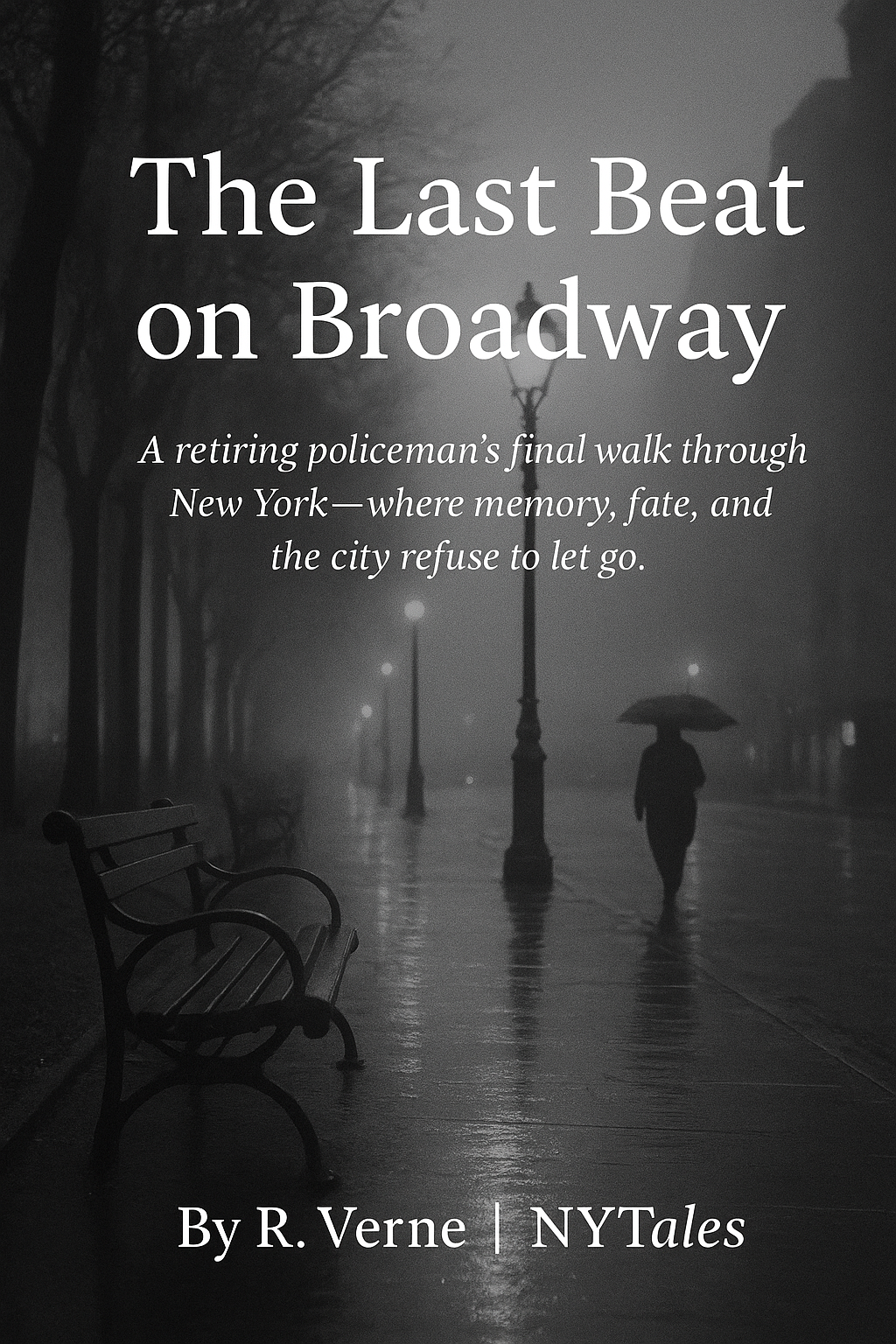
A retiring Black policeman in August 2025 walks his last beat through New York’s layered chaos, intending to leave forever—until fate and the city itself pull him back in.
New York, August 2025.
The humidity lay thick like a stubborn curtain, refusing to part, refusing to allow a breeze to pass through the canyons of Broadway. The city smelled of roasted peanuts from carts, of sweat and the faint bitterness of hot tar that bled under the punishing afternoon sun. Pigeons shuffled lazily in Times Square, cooing over half-eaten bagels abandoned by hurried tourists.
And on that very street, in a uniform that bore the creases of thirty years of service, Officer Jameson Cole walked his last beat.
Cole had joined the NYPD in 1995. Back then, Giuliani’s “broken windows” policing had ruled, the subways still smelled of piss and graffiti, and the towers still rose tall downtown. He had been a young Black man then—proud, upright, determined to prove something.
Now, he was sixty-two. Arthritis in his knees. Divorce papers framed like a diploma on the wall of his one-bedroom Bronx apartment. Children who had stopped returning his calls.
His badge had seen the good: the Puerto Rican Day Parade in 2005 when he danced with the crowd, uniform and all.
The bad: Occupy Wall Street in 2011, where angry protestors spat at him, called him a traitor.
And the worst: George Floyd, 2020. The summer of burning streets, of chants echoing through Manhattan: No justice, no peace! He remembered standing in Union Square, helmet on, shield up, and seeing a child with a placard almost bigger than herself scream at him—“Why are you killing us?” That night, he had gone home, taken off his body armor, and wept.
Now, August 31, 2025, was his last day. Tomorrow he would leave New York for good. Move to Savannah, Georgia, where his cousin ran a small diner. “Peace and grits,” his cousin had promised on the phone.
But as Cole walked Broadway, the city refused to let him go quietly.
On one corner, the shimmering glass of a luxury condo rose where once a tenement stood. Rent for a studio—$5,200 a month. A block away, a man slept on cardboard outside Duane Reade, whispering in dreams about cheeseburgers. A Tesla purred past, whisper-quiet, its driver sipping cold brew from Starbucks Reserve, while at the curb, a delivery man from Queens adjusted the straps on his overloaded e-bike.
“Hey, officer,” a Bangladeshi cab driver leaned out at a red light. “Congratulations on retirement. Thirty years, haan? You survived this jungle!” He laughed, teeth flashing.
“Barely,” Cole muttered, waving.
The billboards screaming AI WILL SAVE YOUR LIFE while small shops shuttered under rising rents. Political posters plastered on scaffolding—“MAKE AMERICA HUMAN AGAIN”—half torn, half graffitied.
At Columbus Circle, Cole paused. The fountain sparkled, tourists taking selfies under the giant globe. A young man selling fake Yankees caps shouted in Spanish.
“Officer! Want one? Discount for you!”
Cole smiled. “My head’s too big.”
The vendor laughed. “New York head, eh?”
He walked on, past the falafel smell wafting from food trucks, past a saxophonist whose music rose like smoke into the night sky, past a group of Columbia students arguing about Gaza and Ukraine in voices meant to be overheard.
At 72nd Street, near the Dakota, he stopped again. Lennon’s ghost still lingered in the hush around Strawberry Fields. There, an old woman sat sketching pigeons.
“You retiring?” she asked, eyes sharp behind thick glasses.
“How’d you know?”
“You have the walk of someone saying goodbye.”
Flashback:
• 9/11. He had run downtown, dust choking him. He remembered a woman’s hand slipping from his grip as the second tower came down.
• 2008. Recession. He had escorted bankers out of Lehman Brothers as they carried their lives in cardboard boxes.
• 2020. Pandemic. The city like a morgue. He had stood outside Elmhurst Hospital, listening to the endless wail of ambulances.
Each layer of the city lived in him like sediment.
By evening, the humidity broke into rain. Broadway gleamed under streetlights. Steam hissed from grates.
He ducked into a diner near 50th Street, the kind that still served filter coffee in chipped mugs.
“Evening, Officer Cole,” the waitress said. Her name tag read Maria. “Heard you’re done after today.”
“That obvious, huh?”
“You’re the last of the old beat cops. My papa used to say—you guys were the city’s spine.”
Cole chuckled. “Now we’re arthritis.”
They laughed. He paid, left a tip larger than usual, and stepped back into the rain.
As he turned toward Times Square, he saw commotion: a young boy—eight, maybe nine—darting into the street, chasing a basketball. A cab screeched. Horns blared.
Instinct. Training. Thirty years condensed into one reflex. Cole lunged, grabbed the boy by his hoodie, yanked him back. They both tumbled onto the curb.
The boy’s mother screamed, rushed forward. “Thank you, officer! Thank you!” Tears mixed with the rain on her face.
Cole’s knees ached, but he smiled. “Just doing my job.”
“Your last job,” someone muttered in the crowd. Applause broke out. A few even filmed on their phones.
Cole stood there, soaked, watching the boy clutch his ball, alive.
Next morning, suitcase packed, ticket to Savannah in hand, Cole reached Penn Station. The announcement board flickered: All departures delayed due to flooding on tracks.
He cursed softly, dragging his bag. Then his phone buzzed—an unknown number.
“Officer Cole?” A familiar voice. It was the boy’s mother. “We saw you on TikTok. The whole city did. My husband’s a councilman in Queens. They want to honor you tonight at City Hall. Please, will you come?”
Cole hesitated. Savannah could wait. Thirty years, and the city that had spat at him, wept with him, ignored him—suddenly wanted to embrace him.
That evening, in his wrinkled uniform, Officer Jameson Cole stood in City Hall, the mayor pinning a medal to his chest. Cameras flashed. Applause thundered.
And as he looked at the medal, he thought with a wry smile—like O. Henry might have written—
He had planned to leave New York forever. Instead, New York finally refused to leave