
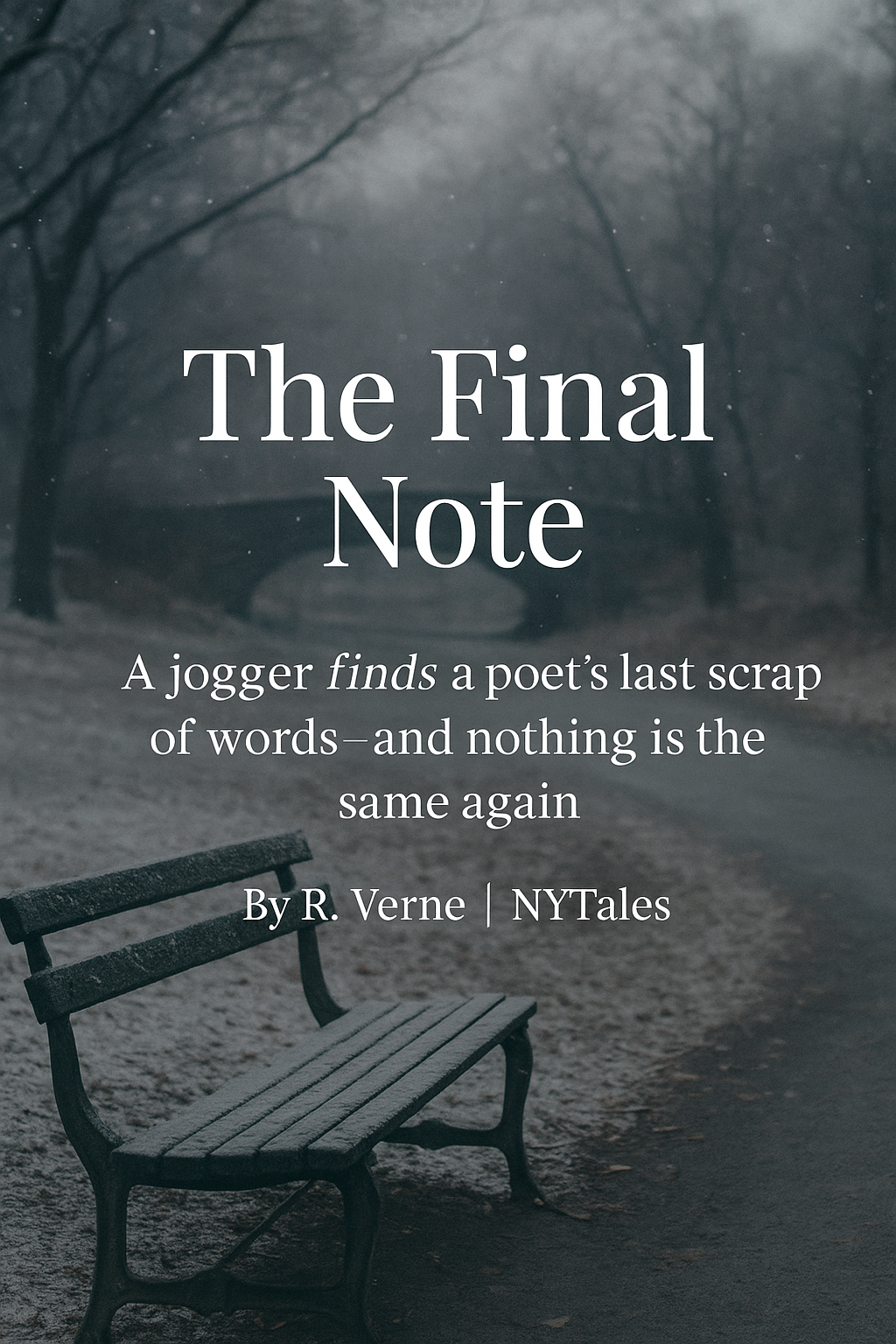
A homeless poet in Central Park leaves behind scraps of words that outlive him. A jogger stumbles upon one—and his life, and countless others, are changed forever.
The wind in Central Park was a quiet thief that morning, carrying away the last warmth of autumn and replacing it with the raw bite of New York’s winter. A thin veil of snow clung to the benches, the statues, the twisted black branches of the elms. It was a city of noise and light, but here—inside the park at dawn—everything slowed into a kind of frozen silence. Even the pigeons kept low, wings reluctant against the cold.
On a bench near the Mall, half-hidden beneath a threadbare army coat, lay a man known to no one and yet recognized by many. He had no address, no office to report to, no digital footprint. But he had a name he hadn’t spoken aloud in years: Samuel Hart. To the joggers, the tourists, the dog walkers, he was simply that homeless guy with the papers. Because Samuel was always writing.
Napkins from diners, brown paper bags from delis, discarded flyers from subway stations—anything with a blank side became a canvas. Words poured out of him, not neat verses with rhymes, but scattered fragments, the kind that sounded like whispers overheard in dreams. Sometimes he left them tucked under stones, sometimes folded into the cracks of benches, as if the park itself were his publisher.
Few stopped to read. Most hurried past, earbuds in, lost in podcasts or playlists, anxious to get steps counted before work.
Among those who ran past him almost daily was Daniel Miller, thirty-six years old, a Vice President at a Midtown investment firm. Daniel was the kind of man who believed in efficiency: his day was scheduled in half-hour blocks, his meals ordered on apps, his heart rate tracked by a sleek black watch on his wrist. To him, running through Central Park wasn’t leisure—it was therapy, an attempt to outrun silence.
Because silence, when it caught him, reminded Daniel of the things he avoided: the death of his father when he was seventeen, the growing distance between him and his younger sister, the fact that despite earning more money than he once dreamed possible, he still ate dinner most nights alone.
On this particular morning, snow just beginning to fall in feathery flakes, Daniel’s shoes crunched against the path as he rounded the bend by the Mall. He noticed the bench ahead, the man hunched, the bundle of papers slipping to the ground. It was a sight he had glimpsed dozens of times, dismissed dozens of times. But today, something caught him.
A single sheet of paper had blown onto the path. It clung to the snow like a pale leaf, words scrawled in shaky but determined handwriting. Daniel slowed, irritated at first by the break in rhythm, but then—curiosity. He bent down, picked it up.
The words were brief, no more than six lines:
I was once a voice among voices,
but the city swallowed me whole.
If you find these words, know this:
we are never as invisible as we fear.
Someone, somewhere, is listening.
Even if only the trees.
Daniel read it twice, then again. Something in the cadence struck him—not polished, not professional, but pulsing with sincerity. He glanced at the man on the bench. Samuel’s eyes were closed, his lips faintly blue.
For the first time in years, Daniel removed his earbuds. The world rushed in: the distant honk of a cab, the scrape of a snowplow, the rhythmic panting of another jogger passing. And underneath it all, the brittle silence of a life that seemed to be ending quietly, unseen.
Daniel stood frozen. His instinct said: keep running, call someone later, don’t get involved. But the note in his hand seemed to weigh a hundred pounds. He slipped it into his pocket, almost guiltily, and forced himself forward, legs heavy, lungs unwilling.
The city swallowed him back into its routines, but something had shifted.
That evening, after the chaos of meetings and market updates, Daniel found himself pulling the note out of his coat pocket. He smoothed it against his desk, read the lines again under the sterile office light. There was no signature, just the smudge of a hand that had pressed too hard against damp paper.
For reasons he couldn’t explain, Daniel googled: “homeless poet Central Park.” The search yielded little—an old blog post, a photo buried in a neighborhood paper. But the fragments he found suggested that this man had been known to locals for years. Some called him “the Scribbler,” others “the Poet of the Mall.”
Daniel closed his laptop, but the note burned in his thoughts long after he turned out the lights.
The following morning, Daniel returned to the same path in Central Park. Snow had thickened overnight, turning the benches into pale mounds. The spot where he’d seen the poet was empty now, except for a scattering of footprints that led away toward Fifth Avenue.
For a moment, he wondered if he had imagined it all—the man, the note, even the faint blue lips. But the paper in his pocket said otherwise.
Daniel lingered by the bench. Joggers zipped past him, glancing briefly as if to say: Why stop? Keep moving. That was the New York code—momentum at all costs. But Daniel, for the first time in years, ignored it. He sat down, listening to the creak of snow beneath him.
Across the path, a hot dog vendor was setting up his cart. Daniel crossed over.
“You know the man who sits there sometimes?” he asked. “Older guy. Worn coat. Always scribbling.”
The vendor paused, adjusting a metal tray. “Ah, you mean Sam.”
Daniel nodded. “Sam?”
“Yeah. Been around here for years. Quiet fella. Writes on anything he can find. Sometimes gives me poems instead of dollars. Haven’t seen him today, though. Maybe the cold got to him.” The vendor’s tone carried a shrug, but his eyes softened. “You liked his poems?”
Daniel hesitated, then pulled out the note. The vendor squinted, then smiled faintly. “Yep. That’s Sam. Always talking about trees listening. Said he trusted trees more than people. Can’t blame him.”
Daniel kept walking, his mind circling. Sam. The name alone made the man less of a ghost. He wondered how many people had walked past without ever asking.
Later that day, Daniel returned with a cup of coffee from a nearby café, hoping to catch sight of him again. Instead, he found a violinist playing beneath the stone arch near Bethesda Terrace. The man’s bow moved with elegance, though his coat was patched and frayed.
Daniel waited for a pause, then asked, “Do you know Sam? The man who writes poems?”
The violinist chuckled softly. “Know him? We’re colleagues. He writes, I play. We both perform for the trees.” He tucked his violin under his arm. “Sam used to be a teacher, you know. English, somewhere upstate. Lost his job, then his family. The bottle found him after that. But he never stopped writing.”
A teacher. Daniel felt a pang. His own father had been a literature professor at a small college in Boston, the kind who recited Yeats at the dinner table. The memory was sharp, unexpected, like a door opening in a house he had locked years ago.
The violinist leaned closer. “If you see him, tell him the park’s quieter without him. He makes the air heavier with words.”
That night, Daniel dreamed of benches lined with notes, scraps of paper fluttering like autumn leaves. In the dream, he bent to pick one up, but the words slipped away before he could read them.
When he woke, he knew he couldn’t let the trail end here.
He began asking more—police officers who patrolled the park, a barista near Columbus Circle, even a doorman who said Sam sometimes sheltered in their lobby until management pushed him out. Each story was a fragment, a piece of mosaic: Sam quoting Shakespeare to pigeons, Sam helping a lost tourist find her way, Sam giving away his gloves to a man shivering worse than him.
The poet, invisible to most, had in fact touched countless lives.
One evening, after another long run cut short by restless thoughts, Daniel stopped at the bench again. Snow was melting into slush, the air sharp with exhaust from cabs. He sat down, pulled the note from his pocket, and read it again under the dim glow of a lamppost.
We are never as invisible as we fear.
The words struck him differently now. They were not a plea but a statement, firm, almost defiant. Sam had believed, even at the end, that presence mattered—even if unseen, even if ignored.
Daniel pressed the paper flat against his knee, and for the first time since his father’s death, he whispered aloud, “I’m listening.”
A week passed before Daniel saw him again.
It was dusk, and the park shimmered with puddles from a daylong rain. Streetlamps flickered on, halos in the mist. Daniel slowed as he approached the familiar bench. There, slumped but alive, sat Sam. His coat was soaked through, his hair plastered to his forehead, but in his hands—still—was a scrap of paper.
Daniel hesitated, then sat beside him. The air smelled faintly of wet leaves and pretzels from a distant cart.
“You’re Sam,” Daniel said softly.
The old man looked up, his eyes startlingly clear, the blue of winter skies. “Some people call me that.” His voice was rough, but not unkind.
“I found one of your notes.” Daniel unfolded the paper, smoothed it. “It… stayed with me.”
Sam studied him for a long moment, then chuckled. “Funny, isn’t it? You write something down thinking the wind will take it, and instead it lands in someone’s pocket.” He tapped the side of his head. “Words are stubborn. They stick.”
Daniel wanted to ask a hundred questions—Why here? Why poetry? What had he lost? But the silence between them felt too sacred to break with blunt curiosity. Instead, he asked, “Do you have more?”
Sam lifted a crumpled plastic bag at his feet. Inside were dozens of scraps: diner receipts, envelopes, even the back of a lottery ticket, all covered with looping handwriting. “Take one,” he said. “The words aren’t mine once they’re written.”
Daniel reached in and pulled out a page. The ink had blurred from rain, but the lines were still legible:
To be heard is to live twice.
Once in the body,
Once in the heart of another.
Daniel felt something in him shift, like a lock turning. He thought of his father reciting poetry to him as a boy, his sister waiting for calls that never came, the long silence he had built like a wall around himself.
He folded the page carefully, as if it were fragile. “Thank you,” he said.
Sam only nodded, then leaned back, eyes closing as though the effort of words had drained him.
Two days later, Daniel returned with fresh clothes, a blanket, and a notebook—clean, uncreased pages. But the bench was empty. He searched nearby shelters, asked vendors, even the violinist. No one had seen Sam. Some said he’d gone to Bellevue, others that he’d simply vanished, as quietly as he had lived.
The absence gnawed at Daniel, but the scraps in his pocket remained, each one a small anchor. He began typing them out at night, building a digital archive. At first it was private, just for him. But soon, almost without thinking, he created a website: The Poet of Central Park. He uploaded Sam’s lines, pairing them with photos of the benches and trees where he had found them.
The response surprised him. Strangers wrote in, saying the poems felt like they were written for them. Joggers, baristas, cab drivers—people who had brushed past Sam without noticing—shared how his words now accompanied their commutes, their sleepless nights, their small acts of kindness.
Sam had become what he always was: not invisible, but multiplied, living twice, maybe thrice, in the hearts of others.
One evening, as Daniel closed his laptop, he read again the note that had begun it all:
We are never as invisible as we fear.
For the first time in decades, Daniel picked up the phone and dialed his sister’s number.
When she answered, he whispered, almost to himself, “I’m listening.”